Get evidence-based insights on hormones, fertility, and women's health delivered weekly to your inbox.
.svg)
.svg)


©2026 Dr. Sasha Hakman, MD. All Rights Reserved
As a fertility specialist, I am often struck by how little many women understand about their own bodies, particularly when it comes to the menstrual cycle. Despite its central role in female reproductive health, many lack a clear understanding of the phases, timing, and hormonal shifts that occur throughout the cycle. This knowledge gap can lead to confusion about fertility, misconceptions about their bodies, and missed opportunities to optimize reproductive health.
By gaining a deeper understanding of the menstrual cycle, women can not only enhance their chances of conception but also cultivate a more empowered relationship with their health. In this blog post, I’ll break down the phases of the menstrual cycle and explain its implications when trying to conceive.
The menstrual cycle is a monthly hormonal process that prepares a woman’s body for pregnancy—whether or not she desires it (this is where contraceptives play a role). Each cycle is counted from the first day of one period to the day before the next period begins. A typical cycle lasts between 21 and 35 days. Cycles shorter than 21 days are considered too frequent, while those longer than 35 days are too prolonged.
As a fertility doctor, I often become concerned when a woman reports her cycles are becoming shorter than 25 days, as this can be an indicator of diminishing ovarian reserve.
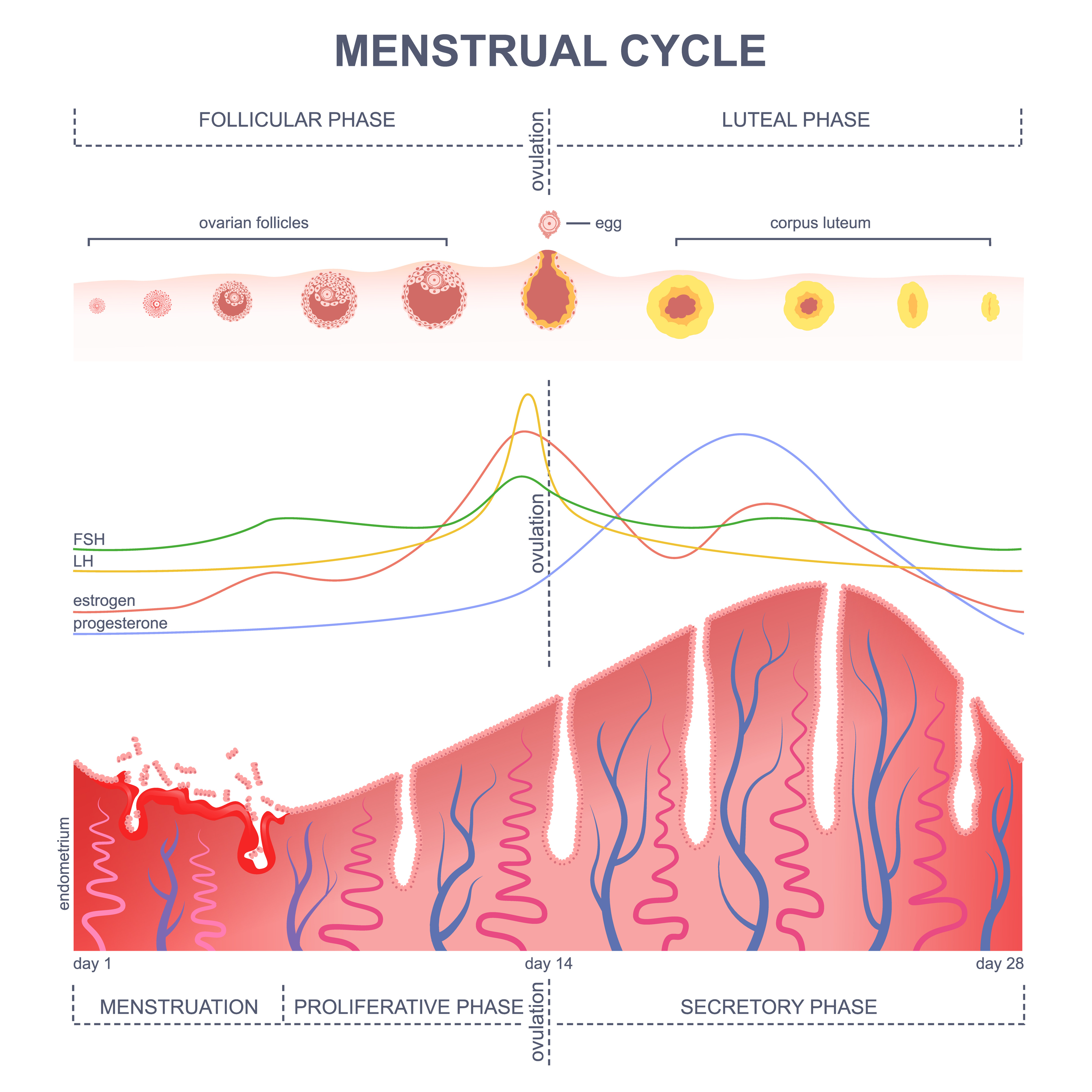
The menstrual cycle is divided into four main phases:
This is the phase commonly known as your period. The menstrual phase is marked by the first day of a full bleed (anything more than light spotting), known as cycle day 1. On average, menses lasts 3 to 7 days. During this time, the lining of the uterus (called the endometrium) is shed since pregnancy did not occur in the previous cycle and occurs in response to progesterone withdrawal (more on this coming up!).
Hormonal changes:
The follicular phase starts on the first day of your period and continues until ovulation. During this phase, the brain signals the ovaries to prepare eggs for release. The pituitary gland releases follicle-stimulating hormone (FSH), which stimulates the follicles in the ovaries to grow. Follicles are small, fluid-filled sacs that each contain an egg. Though several follicles start to grow, only one will dominate and eventually release a mature egg, while the other follicles degenerate.
Hormonal changes:
Ovulation is the release of a mature egg from the dominant follicle in the ovary. This is the most fertile time in the cycle, when the egg can be fertilized by sperm (be sure to check out my upcoming blog post on the best way to track ovulation and your peak fertility). Ovulation typically occurs about 14 days before the start of the next menstrual period, regardless of the cycle length. Once the egg is released, it is picked up by the fallopian tube, where it may meet sperm and become fertilized.
Hormonal changes:
After ovulation, the luteal phase begins, typically lasting 14 days (though it can range from 11-17 days). The empty follicle that released the egg transforms into the corpus luteum, which secretes progesterone (and some estrogen). Progesterone helps maintain the thickened uterine lining, making it “sticky” in case an embryo implants and pregnancy occurs.
Hormonal changes:
While this is a simplified version of what does on during the menstrual cycle, it helps to understand the purpose of each phase. The more you track your cycles, the more in tune you become with your body’s menstrual patterns which can provide a lot of insight on your reproduction and your health! Think of your menstrual cycle as a vital sign!
Want to learn more? Contact us at 310-943-5820 or email BH_Reception@havingbabies.com or fill out a form today to schedule a consultation!
.png)
Connect with one of our experienced fertility specialists to explore your options. We’re here to guide and support you every step of the way.
Book an AppointmentGet evidence-based insights on hormones, fertility, and women's health delivered weekly to your inbox.
©2026 Dr. Sasha Hakman, MD. All Rights Reserved